


![[Energy Column] SAF Roadmap Announced… Could It Be a New Growth Engine for the Refining Industry? | img1](http://gscaltexmediahub.com/wp-content/uploads/2025/09/img1.png "[Energy Column] SAF Roadmap Announced… Will It Become a New Growth Engine for the Refining Industry?")
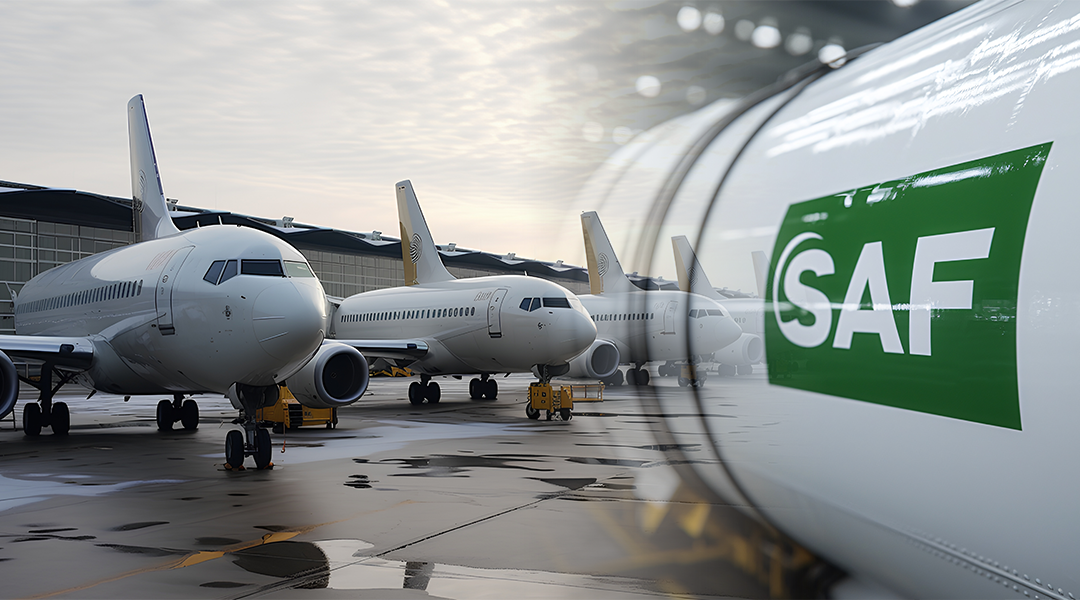
The South Korean government will introduce a system requiring the use of Sustainable Aviation Fuel (SAF) on international flights departing from Korea starting in 2027. The initial blending ratio will begin at 1%, gradually increasing to 3-5% by 2030 and 7-10% by 2035.
Announcement of the Roadmap for the Domestic SAF Blending Mandatory System
On September 19th, the Ministry of Trade, Industry and Energy and the Ministry of Land, Infrastructure and Transport announced the “SAF Blending Mandatory System Roadmap” in Seocho-gu, Seoul, with representatives from the oil refining, aviation, and related organizations in attendance. They also officially launched the “SAF Alliance,” a public-private partnership. The roadmap includes mandatory blending ratios by year and support measures to foster the SAF industry.
SAF is an eco-friendly aviation fuel made from renewable raw materials such as animal and vegetable oils, waste cooking oil, and seaweed. The government plans to increase SAF production to achieve carbon neutrality and foster new industries. The obligation to supply aviation fuel applies to refineries and petroleum exporters and importers. Compliance with the obligation is based on the annual domestic SAF supply compared to the international aviation fuel supply at domestic airports.
The government has decided to implement a flexible system, allowing 20% of the compliance obligation to be carried forward for up to three years. It also plans to add a system that allows for temporary relaxation of the mandatory ratio in unavoidable circumstances, such as natural disasters. The fueling obligation will apply to all domestic and international flights. A pilot program will begin in 2028, and fines for noncompliance will be imposed starting in 2029. However, new airlines will receive a three-year grace period.
The government has also established incentives. National airlines exceeding their mandatory SAF usage will be given bonus points when allocating international traffic rights, and airport facility usage fees will be reduced or subsidized for SAF-mixed refueling flights. There are also incentives for airline passengers. If passengers voluntarily contribute to SAF, airlines can offer additional benefits such as lounge access, priority seating, and souvenirs.
Driving SAF Industry Growth with Financial Support
The government’s support for the growth of the SAF industry will also be strengthened. By designating SAF as a national strategic technology, tax incentives will be provided for research and development (R&D) and production facility investments in bio-based SAF. Additional incentives for next-generation regenerative synthetic SAF are also being considered.
To stimulate new investments, policy financing support will also be provided. Measures will include designating key raw materials for SAF as core economic security items and providing funding for facility investment and raw material purchases. Development of new materials such as microalgae will be strengthened, and domestic tariff reductions will be pursued for biomaterials not eligible for tariff benefits under free trade agreements (FTAs). Furthermore, a global biomaterial supply chain map will be established to establish a foundation for raw material supply.
![[Energy Column] SAF Roadmap Announced… Could It Be a New Growth Engine for the Refining Industry? | img2](http://gscaltexmediahub.com/wp-content/uploads/2025/09/img2.png "[Energy Column] SAF Roadmap Announced… Will It Become a New Growth Engine for the Refining Industry?")
The conflicting views between the aviation and oil industries
This policy is intertwined with the global SAF market debate. Airlines and oil companies are locked in a conflict: “supply increases only when there’s demand,” while others argue that “demand only arises when supply is supported.” The biggest burden for airlines is the price of SAF, which is two to three times higher than conventional aviation fuel.
According to the International Air Transport Association (IATA), SAF will account for only 0.2% of global aviation fuel supply in 2023. Airlines argue that high prices due to the supply shortage are the problem. Conversely, refiners argue that they cannot make large-scale investments because airlines do not have long-term purchase contracts. Indeed, Shell has halted construction of a SAF and renewable diesel plant in Rotterdam, the Netherlands, and Italy’s Eni is currently producing SAF only when there are orders.
Europe has already mandated the use of SAF. Starting this year, the EU has mandated that at least 2% of aviation fuel be SAF, with a target of increasing this to 70% by 2050. The UK is also increasing this requirement to 22% by 2040.
![[Energy Column] SAF Roadmap Announced… Could It Be a New Growth Engine for the Refining Industry? | img3](http://gscaltexmediahub.com/wp-content/uploads/2025/09/img3.png "[Energy Column] SAF Roadmap Announced… Will It Become a New Growth Engine for the Oil Refining Industry?")
The significance and challenges of the Korean SAF roadmap
Although Korea’s SAF roadmap began later than Europe, it is characterized by a flexible institutional design, including phased expansion, and a parallel approach to support. Its strength lies in its designation of the SAF industry as a national strategic technology and its proposal of multifaceted support measures, including tax credits for R&D and facility investment, policy financing, designation of raw materials as economic security items, and tariff reductions. In particular, the plan to create a global raw materials supply chain map and promote stable supply is considered a realistic solution.
However, from the perspective of oil refining companies, there are many challenges. First and foremost is the lack of economic feasibility. SAF production costs are high, and it’s difficult to simply convert existing refining processes. Domestic refineries consider securing stable, long-term demand a top priority before large-scale facility investments, a common debate in the global SAF market.
Global competition is intensifying. The United States is offering tax credits and subsidies to SAF manufacturers, and Japan is accelerating commercialization through public-private consortiums. If Korea falls behind, airlines risk becoming dependent on SAF imports from overseas.
Compliance with international regulations is also a key issue. The International Council of Agricultural Organisations (ICAO) is currently discussing international certification standards for biodiesel and bio-naphtha, which are produced together with SAF blending. If Korea fails to proactively secure these standards, its entry into export markets could be blocked.
An energy policy expert said, “The SAF blending mandate could be an opportunity for domestic refineries to secure a new growth engine,” and added, “If they can increase production based on the domestic mandate and supply SAF to global airlines, it could lead to strengthening the competitiveness of aviation fuel exports.”
Article by Kim Ri-an, Korea Economic Daily reporter
※ This content was written with a contribution from Kim Ri-an, a reporter for the Korea Economic Daily.