




The oil refining industry, a key driver of the Korean economy and a key industry, is facing an unprecedented crisis. Refining margins have steadily declined for the past three years, and all refineries are estimated to have posted operating losses in the first half of this year. While oversupply and slowing demand within the region are cited as the primary causes in the short term, the long-term impact of the energy transition threatens the industry’s very survival. The Korean oil refining industry has maintained world-class competitiveness through proactive and bold investments. Investments in upgrading facilities, worth trillions of won, have been a key driver in converting cheap heavy oil into high-value-added light oil, significantly contributing to increased exports and national economic development. However, the oil refining industry now faces a massive paradigm shift: carbon neutrality and energy transition. The success formula of the past cannot guarantee the future. Now, bold structural reforms and future-oriented investments are urgently needed to achieve sustainable growth.
However, even at a time when preparing for the future is more crucial than ever, long-standing misconceptions continue to hold back the oil refining industry. For example, the oil refining industry has been constantly criticized, with baseless misconceptions that it relies on an oligopolistic domestic market or that it reaps excessive profits from oil prices. However, the reality is different. As of 2024, the oil refining industry is expected to become a leading export industry, accounting for 60% of sales, and petroleum products are Korea’s fourth-largest export item, following semiconductors and automobiles. Unfounded misconceptions breed distrust, and we must not allow this distrust to hinder the development of key national industries. Therefore, we will examine how oil prices are determined and address some of the most common misconceptions surrounding the oil refining industry.

Among the misconceptions about the oil refining industry, perhaps the most entrenched and long-standing is the mistrust surrounding pricing. Consumers often focus solely on the final price they see, mistakenly believing that refineries are profiteering. However, based on 2024 gasoline prices, international crude oil prices and taxes, which are raw material costs, already account for 91.3% of the selling price. Meanwhile, the combined cost of refining, transportation, investment, labor, and margins amounts to 8.7%, or approximately ₩134.0 per liter. The average operating profit margin for refineries from 2010 to 2024 was approximately 1.5%. Assuming they simply sell gasoline, applying this assumption, the margin for gasoline sold at ₩1,541.1 per liter would be only ₩23.1.
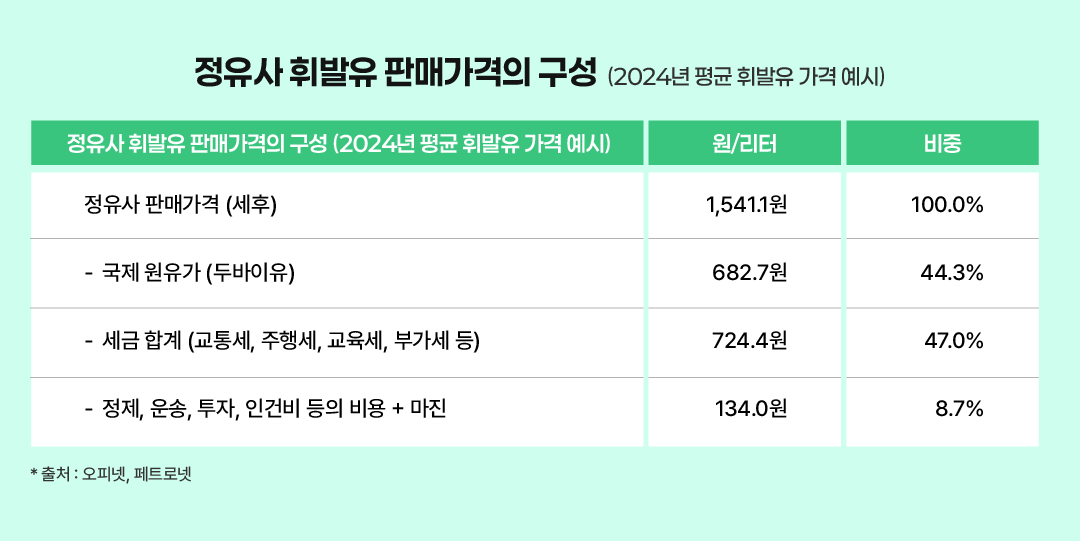
A price cut of 10 won per liter may not seem significant to consumers. However, a loss of 10 won per liter for refineries has a completely different meaning. According to the Korea National Oil Corporation, domestic gasoline and diesel consumption will reach 40 billion liters in 2024. If refineries were to accept a loss of 10 won per liter, this would lead to a significant annual loss of 400 billion won. Conversely, if refineries generated profits commensurate with the perceived profits of consumers, the industry’s operating profit margins should naturally be high. However, the reality is quite the opposite. As mentioned earlier, the average operating profit margin of domestic refineries from 2010 to 2024 was a mere 1.5%, a very low figure that falls far short of the manufacturing industry average.
So, why do consumers harbor these misconceptions about the oil refining industry? There are several reasons, but the most significant one is undoubtedly a lack of information. If consumers understood the production process and costs, including international oil prices, crude oil imports, inventory, refining, taxes, and gas station distribution, unnecessary misunderstandings would be avoided. While understanding all of these is impossible, the simple explanation of the pricing structure above should have helped to alleviate some of the misconceptions about profiteering. The second cause of consumer misunderstandings is likely loss aversion bias. Consumers typically experience the pain of losses more intensely than the joy of gains. Consequently, many consumers believe in the existence of price asymmetry—gasoline prices rise as fast as a rocket, but fall as slowly as a feather—and base their belief in oil refining companies’ profiteering on this assumption.
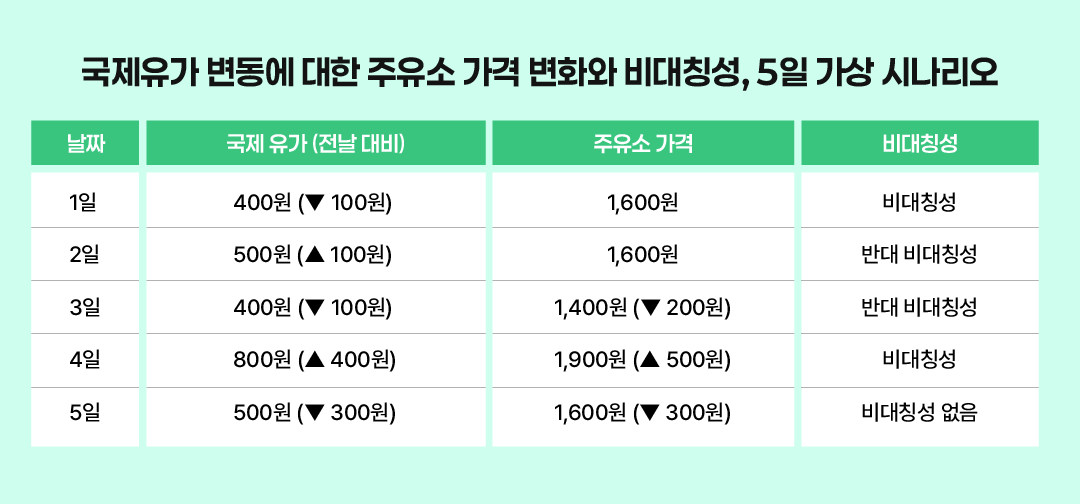
For example, in a five-day price fluctuation scenario, if international oil prices fall on the first day but gas station prices remain the same, consumers perceive an asymmetry even though the gasoline stored at gas stations is the same as before the price drop. On the second day, international oil prices rise, but gas stations maintain their prices based on the previous day’s price. On the third day, international oil prices fall by 100 won, but gas station prices fall by 200 won. Both days exhibit the opposite asymmetry. However, unless there is a price increase, consumers do not react sensitively. On the other hand, if international oil prices surge by 400 won on the fourth day and gas stations raise their prices by 500 won, taking into account the previous day’s price, consumers perceive the asymmetry significantly. Ultimately, no asymmetry occurs over the five-day cumulative period. However, consumers perceive the asymmetry more strongly through their individual experiences on the first and fourth days, particularly on the fourth day. This demonstrates the onset of loss aversion bias. As a result, consumers perceive the market as unfair, reacting only when oil prices rise, and they often escalate this discontent into criticism of oil refineries. Of course, even objective analyses by economists generally reveal asymmetries at the gas station (retail) level, where consumers experience the market. However, the degree of asymmetry differs significantly from what consumers perceive. Moreover, not only does asymmetry tend not to be evident in refinery (wholesale) prices, but even if it does exist for a period of time, it remains difficult to link this to increased profits for refineries.
Another factor that further solidifies distrust of the oil refining industry is likely the preconceived notion of an oligopolistic market. Because the industry is structured around a small number of large companies, consumers assume there’s little competition among refineries, leading to the misconception that refineries can reap excessive profits. However, due to the nature of the refining industry as a process industry, oligopolies are common worldwide. Nearly half of the 32 OECD countries have only one or two refineries. Furthermore, an oligopolistic structure itself does not imply a lack of price competition. Korea’s four major oil refineries are clearly engaged in fierce market competition, as evidenced by the dynamic changes in their market shares over the past decade. Furthermore, competition among the four refineries is indirectly driven by their distribution network of approximately 10,000 gas stations nationwide and through localized price competition among gas stations carrying their respective brands. This differs from products like cigarettes and books, which have uniform prices nationwide, or automobiles and electronics, which maintain similar prices based on headquarters policies. Competition among the four major oil companies is a combination of macro-level competition at the wholesale level and micro-level competition among numerous gas stations.
The misunderstanding surrounding the oil refining industry is likely the result of a complex mix of factors, including a complex pricing structure, a lack of understanding of statistics, and the preconception that it is an oligopolistic market. However, despite the negative consumer perception, the oil refining industry, despite its low operating profit margins, continues to play a pivotal role in the national economy and invests in the future. According to the Korea Petroleum Association, the industry plans to invest over 7 trillion won in future businesses, including petrochemicals, carbon neutrality, and biofuels, by 2026 to overcome the crisis. However, for the Korean oil refining industry to overcome the significant changes brought about by the energy transition through innovation, the industry’s efforts must be accompanied by clearing away misunderstandings and distrust, and by fact-based social discussion and rational policies. In particular, regulations based on distorted perceptions must not be allowed to hamstring the industry and undermine national competitiveness. Now more than ever, the oil refining industry needs warm encouragement and a balanced perspective.