


1. The crisis of the petrochemical industry and the Yeosu National Industrial Complex
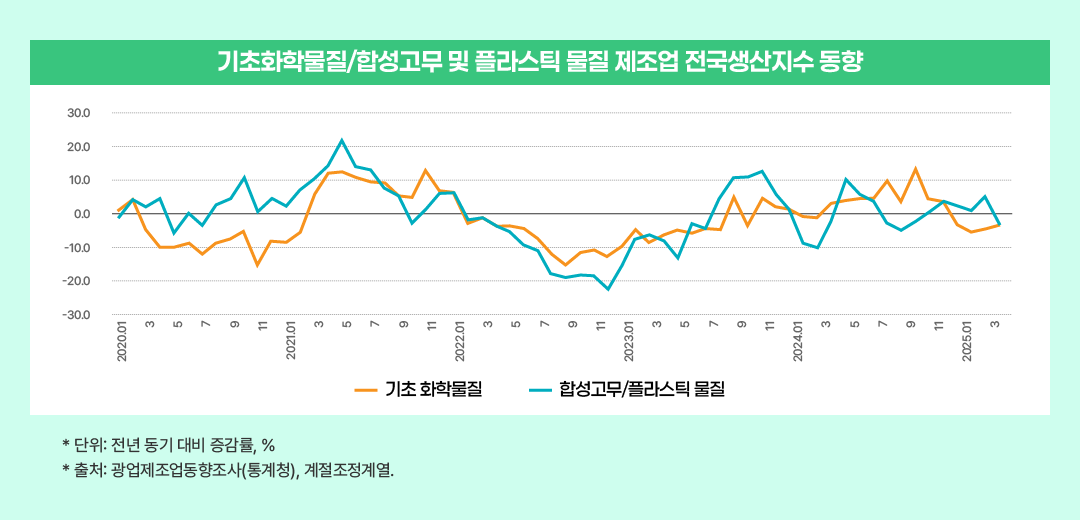
The Yeosu National Industrial Complex, a key hub for the petrochemical industry and a cornerstone of the regional economy, began to falter in the first quarter of 2022. Production indices for basic chemical manufacturing and synthetic rubber and plastic materials manufacturing declined sharply, leading to ongoing slumps. While some improvement appeared in 2024 due to a base effect, the industry’s sales slump and export declines have in fact worsened in 2025.
This situation became an issue during the last presidential election, leading some in political circles to refer to the eastern part of South Jeolla Province, home to a concentration of petrochemical and steel industries, as the “K-Rust Belt.” Like the Rust Belt, a region of declining manufacturing cities in the American Midwest, this serves as a warning that a “rust belt” has emerged in South Korea, demonstrating the need for a new turning point.
The Yeosu National Industrial Complex is a symbol of South Korea’s industrialization. However, as technological prowess and competitiveness in the petrochemical industry shifted from Japan to Korea, and then from Korea to China, the eastern part of South Jeolla Province, including Yeosu, is facing a complex crisis: declining exports, stagnant employment, youth exodus, aging facilities, and pressure to achieve carbon neutrality. Reflecting this sense of crisis, the term “K-Rust Belt” emerged, but it doesn’t simply signify the region’s decline. Behind this, lurking anxiety and concern within the local community: “Are we being forgotten?” and “Are we disappearing?”
So how should we interpret the term “K-Rust Belt”? The key isn’t the negative connotation itself, but rather the task of embedding the future to transform crisis into opportunity. Just as the US’s “Rust Belt” is a term that recalls past glory while also emphasizing the need for a new transformation, the K-Rust Belt should be reborn as the K-Green Belt or K-Innovation Belt.
Now is the time for the Yeosu region, businesses, and government to work together to write a narrative of transformation.
Given the global trend toward carbon neutrality, the petrochemical industry will inevitably undergo restructuring and qualitative transformation. By leveraging the industrial foundation, technological capabilities, and talent pool accumulated over time, we can seize the opportunity to transition to an eco-friendly, carbon-neutral, circular economy.
Companies in the Yeosu Industrial Complex, including GS Caltex, are already leading the way in decarbonization and ESG management. This means there’s significant potential for the belt to transform from a “rusty” belt to a “re-plated belt,” and even a “shining belt.” If the local community and businesses recognize this crisis as an opportunity and work together, we can move beyond the “K-Rust Belt” to a “K-Green Belt.”
2. Yeosu National Industrial Complex at a Crossroads
The Yeosu National Industrial Complex is Korea’s largest petrochemical complex and a key national industrial hub, serving as an export outpost. As of 2024, it is expected to account for 12.1% (KRW 87.7 trillion) of national industrial complex production and 13.6% (USD 31.9 billion) of exports, making it an indispensable industrial hub for both the national and regional economies. However, the complex currently faces numerous challenges.
First, the relatively high concentration of a single industry in an industrial structure is exacerbating the regional economic difficulties. According to the 2023 Mining and Manufacturing Survey, petroleum refining and chemical industries account for 67.4% of the workforce and 96.3% of the added value in the Yeosu manufacturing sector. Consequently, a crisis in the petrochemical industry immediately spreads widely to plant construction, nearby restaurants, food materials, and logistics and transportation. While the concentrated heavy chemical industry in eastern Jeollanam-do was a boon during the industrialization era, in the era of the Fourth Industrial Revolution, it is now a key factor preventing economies of scope.
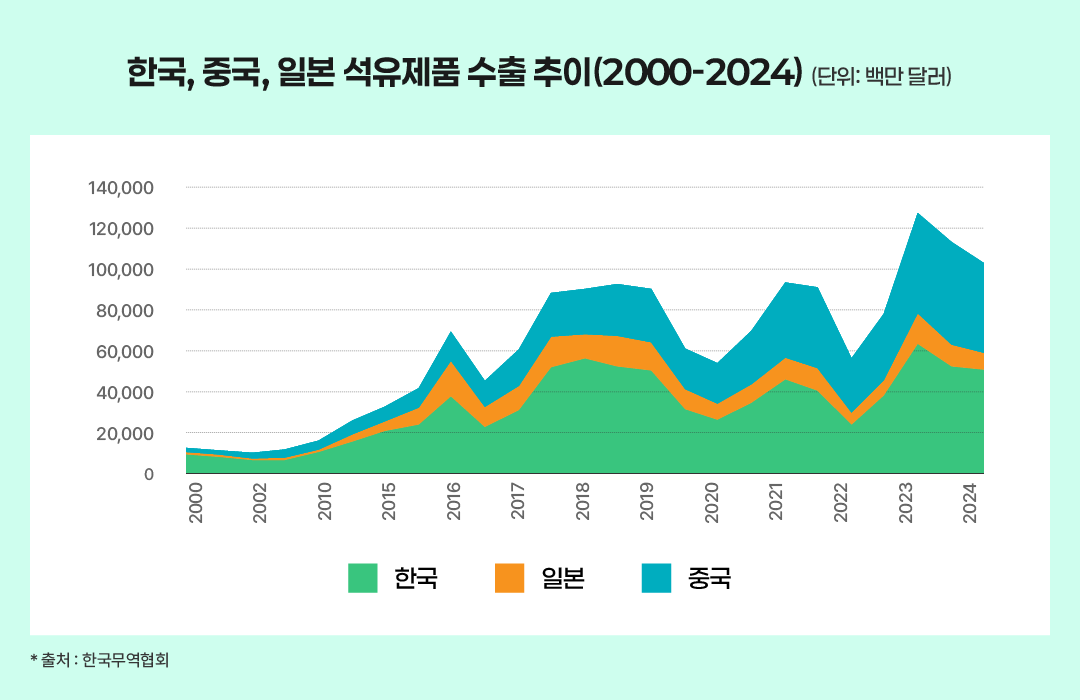
Second, the leadership in the petrochemical industry is shifting. While Japan once dominated the petrochemical industry, Korea dominated the export market in the 2000s. However, over the past several years, the industry’s focus has shifted due to China’s relentless pursuit and massive capacity expansion in the Middle East. Increased production in China and the Middle East has directly led to a price war in the export market, eroding the profitability of companies in the Yeosu National Industrial Complex. China’s growth has been particularly rapid, and considering that its petroleum product exports have recently nearly caught up with those of Korea, the sense of change is palpable. Ultimately, to gain an edge in competition with China and the Middle East, Korea must leverage its technological prowess to develop high-value-added products and maintain export and domestic markets.
Third, the global trend toward decarbonization and carbon neutrality is gaining momentum. This trend poses two major challenges for the domestic petrochemical industry: decreased demand and increased costs due to shifts in production methods. First, the global shift toward carbon neutrality is expected to lead to a decline in fossil fuel use. While this will vary depending on the scenario, demand for coal, oil, and natural gas is expected to decline to a certain level compared to the past. Consequently, the existing petrochemical industry, particularly crude oil refining, will face a significant decline in demand. This will require not only responding to or adapting to carbon neutrality, but also a mid- to long-term structural transformation of the entire industry to ensure its survival. Meanwhile, the petrochemical industry’s traditional production methods, characterized by massive energy inputs and significant carbon emissions, require a fundamental shift to low-energy, low-carbon methods. This requires significant investment of time and money, yet most countries, including China and Europe, are focusing both government budgets and corporate investment on expanding research and development and demonstrating carbon capture, utilization, and storage (CCUS) technology. While our country continues to receive government support and industry efforts, we must benchmark the carbon neutrality implementation plans of major countries and strive for greater progress.
Amidst this complex crisis, employment in the Yeosu area is deteriorating both quantitatively and qualitatively, and the local economy is also suffering. As plant operating rates decline, the management of in-house subcontractors in the plant construction, logistics, machinery, and equipment sectors is also deteriorating, leading to increased job insecurity. Consequently, young people are leaving Yeosu in search of jobs, and the population is declining, putting the Yeosu National Industrial Complex at a critical juncture.
3. The Duality of the ‘K-Rust Belt’
It’s true that the term “K-Rust Belt” played a significant role in raising awareness and raising national awareness of this complex crisis. It also had a positive effect, raising awareness of the petrochemical industry’s crisis and stimulating national interest in the region. The region’s designation as a preemptive industrial crisis response zone last May likely contributed to this.
However, this investigation can be a double-edged sword, as it can also lead to a stigmatizing effect due to the negative image it creates. If the perception of the area as a declining region and a stagnant industrial zone solidifies, it could make it more difficult to attract investment and talent. This is especially true for local residents, who may feel a sense of helplessness rather than hope.
Above all, it’s crucial to go beyond simply declaring a crisis a crisis, but to collectively consider how we can transform ourselves amidst it. The government and the public have been informed of the regional and industrial crises through various channels. To turn this crisis into an opportunity and achieve a new leap forward, not only the industry sector, but also the government, local governments, and civil society must work together.

4. Industrial Transition: Designing a New Future for Yeosu
To overcome the crisis facing the petrochemical industry and the difficulties facing the Yeosu regional economy, the most crucial task is the advancement and diversification of the industrial structure. To increase the added value of the traditional petrochemical industry, it is necessary to transition to emerging eco-friendly, high-value-added industries such as bioplastics, hydrogen energy, and advanced materials. Crucially, large corporations and SMEs must innovate their division of labor as co-creators of the industrial ecosystem. For example, GS Caltex is leading future investments in energy transition and industry diversification, including the commercial production of biobutanol, the development of waste plastic pyrolysis technology, and the construction of hydrogen charging station infrastructure. If SMEs partnering with GS Caltex can keep pace with these changes, participate in R&D, develop high-value-added related products, and achieve shared growth, the health of the industrial ecosystem will be enhanced.
Innovation in production methods is crucial, but we must also consider the recent advancements in AI technology that can enhance productivity and safety. Therefore, AI-based process optimization can boost productivity, and digital maintenance and integrated control systems can be used to reduce safety accidents in production sites. By doing so, we can shed the image of the heavy chemical industry as an outdated and dangerous industry and transform into a smart chemical materials industry.
Seizing new opportunities requires nurturing talent and ensuring that they remain. The petrochemical industry is capital-intensive, so it’s easy to overlook the importance of human resources. However, the importance of skilled workers is even greater than in labor-intensive industries. The ongoing exodus of young people amid the current crisis is a matter of urgency. To prevent young people from leaving for other regions in search of education and jobs, we must improve settlement conditions and expand educational opportunities. Specifically, to cultivate the essential workforce for the petrochemical industry, utilizing vocational high schools or expanding work-study programs at local universities through industry-academia collaborations will help reduce youth exodus and revitalize the local economy.
Finally, a system of organic cooperation between the government, local governments, and industry is essential. The government has already provided support through the designation of the region as a preemptive industrial crisis response zone. If this opportunity is used to restore the health of the industrial ecosystem and local governments and industry collaborate to overcome the challenges facing the local economy, the Yeosu National Industrial Complex can once again become a driving force for the future of Korean industry.
5. Yeosu National Industrial Complex, from ‘K-Rust Belt’ to ‘K-Green Belt’
The etymology of the word “crisis” (危機) holds the theory that danger (危) and opportunity (機) coexist. The Yeosu National Industrial Complex still retains the world-class infrastructure it has built over the years, and its skilled technical workforce and competitive companies firmly support the petrochemical industry ecosystem. At this turning point, if we restore the dynamism of the ecosystem and join forces with the local community as a sustainable traditional energy industry, we can achieve a new leap forward.
Now is the time to design a new future, not a “K-Rust Belt,” but a “K-Green Belt.” At the center of this vision lies the city of Yeosu, the Yeosu National Industrial Complex, South Jeolla Province, and the residents of the Gwangyang Bay area. We must create a melody of hope so that the leaders of the industrial era can become the new leaders of the Fourth Industrial Revolution and the transition to carbon neutrality.