



Japan’s Manufacturing DX: Combining Skilled Technology with Advanced Technology
Japan’s manufacturing industry is pursuing both productivity and sustainability through digital transformation (DX). While digitalization has been slow, particularly in public institutions, private manufacturing companies are expanding their efforts to integrate on-site expertise with digital technologies, and best practices are emerging at the individual company level.
In particular, the refining, chemical, and energy sectors are accelerating process automation, energy savings, and carbon neutrality by digitizing skilled skills through cutting-edge digital technologies like AI, IoT, and digital twins. These DX practices are expected to go beyond simple technology adoption and become established strategies that fundamentally transform corporate operations and business models.
DX Cases of Japanese Oil Refining, Chemical, and Energy Companies
ENEOS – AI-based autonomous driving and GX linkage strategy
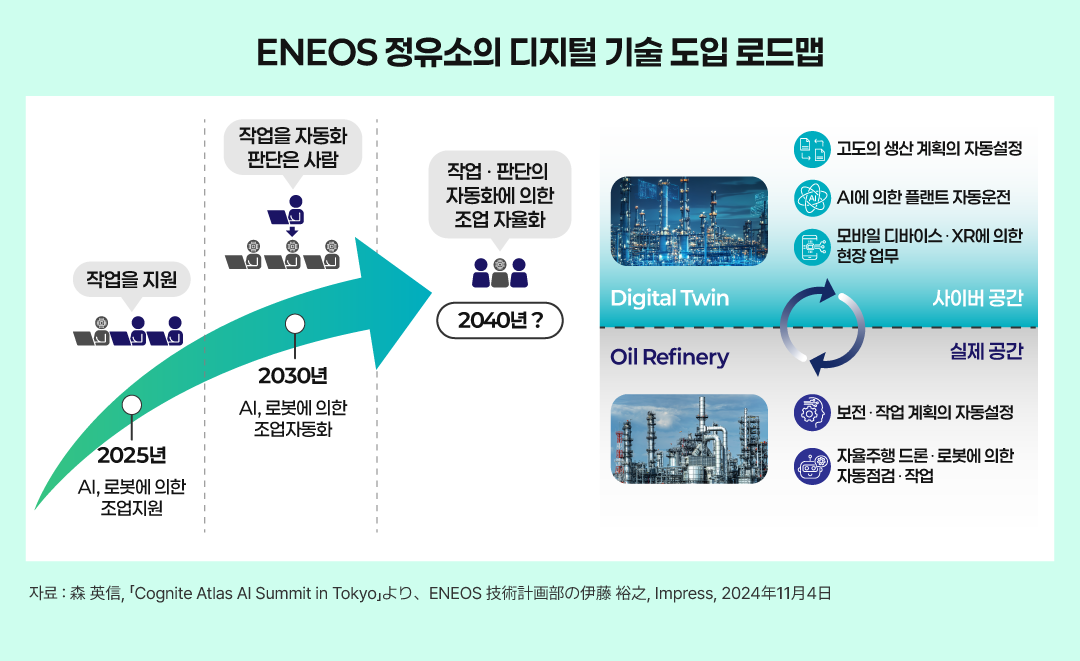
ENEOS, Japan’s largest oil refining company, has commercialized the world’s first AI-powered automated refinery operation technology. This system monitors 24 operating factors in real time through 930 sensors and features a high-precision operating system capable of simultaneously controlling up to nine valves. The AI learns from experienced operators, enabling it to flexibly respond to external disturbances such as weather and raw material fluctuations. Its anomaly detection system proactively prevents problems.
In terms of on-site automation, digital twin and XR technologies are being actively utilized. Inspections using autonomous drones and robots, AI-based automated production planning, and predictive maintenance systems reduce energy consumption and enhance safety. ENEOS plans to further enhance these capabilities by introducing Agent AI technology, transforming the factory into a smart factory capable of autonomously optimizing production processes.
Idemitsu Kosan: An Energy Service Hub Evolving into a “Smart General Store”
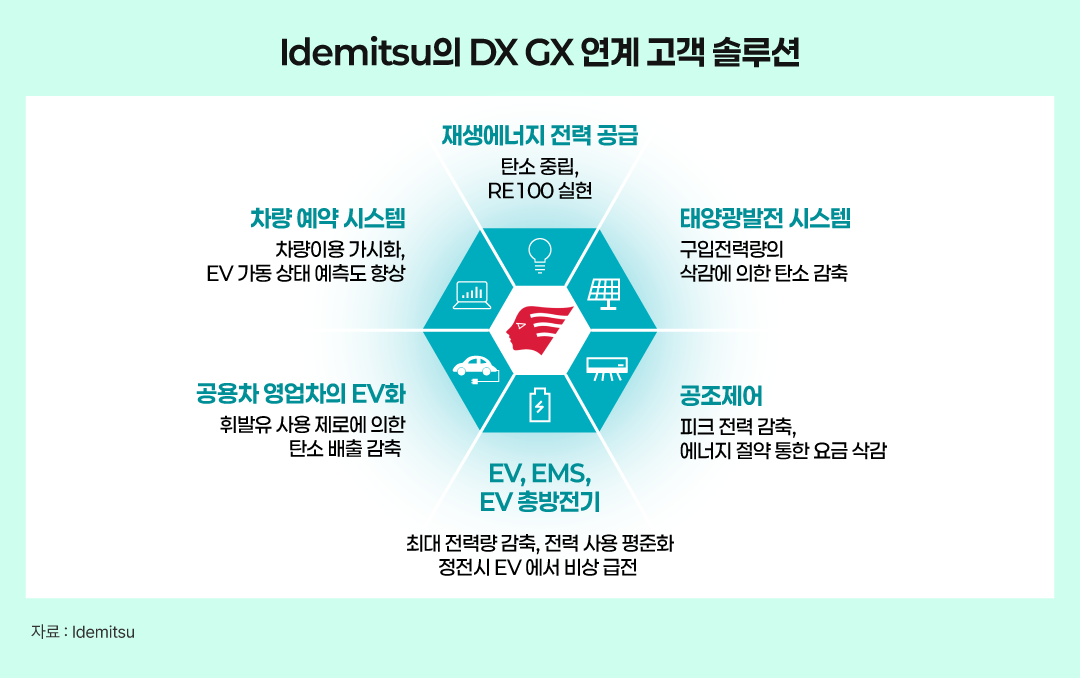
Idemitsu Kosan is transforming beyond its traditional refining and chemical operations into a regionally focused digital platform company. At the heart of this transformation lies a unique DX strategy called “Smart General Store.”
“Smart Everything” is an attempt to redefine the nation’s approximately 6,400 service stations (SS) beyond mere gas stations into hubs of local communities. Through this initiative, the company is building a platform that integrates a variety of lifestyle services beyond energy supply.
For example, we offer energy-saving solutions that integrate solar power generation with EV charging systems, and optimize local power supply and demand through virtual power plants (VPPs). Furthermore, we are transforming SS into a space that supports the convenience and well-being of local residents by adding mobile health screenings, shared mobility, and regional logistics hub functions.
Mitsubishi Chemical – MI-based materials development and autonomous processes
Mitsubishi Chemical is revolutionizing materials development by leveraging Materials Informatics (MI) and generative AI. AI automatically generates molecular structures, predicts reaction pathways, and assesses synthetic feasibility. It also derives design proposals based on similar cases by learning from past experimental data. Through a proprietary application called “MI Bridge,” researchers and data scientists collaborate, and autonomous equipment diagnostics and quality control are also implemented, linked to smart factories.
Asahi Kasei – Business Innovation Centered on the Digital Creation Headquarters
Asahi Kasei has established the “Digital Co-Creation Headquarters” to promote digital transformation (DX) as a core strategy for organizational innovation and to drive it company-wide. This headquarters is not simply an IT support department; it functions as a strategic hub connecting business units and the field, simultaneously driving value creation through DX and improving organizational culture. It emphasizes field-oriented problem-solving and integrates digital technologies into each department’s tasks to drive tangible improvements.
To establish a data-driven decision-making culture, the Digital Co-creation Headquarters is redesigning and automating processes across each business unit. To achieve this, it is building an in-house data platform and integrating various technologies, including AI, IoT, and RPA, to enhance productivity and agility. Furthermore, it is strengthening collaboration across departments, operating training programs and communities to cultivate digital talent, and enhancing digital capabilities across the entire organization.
JERA – AI Power Plant and Blockchain-Based Energy Platform
JERA, Japan’s largest energy company, has implemented an AI-based power plant operation system at 26 locations nationwide. This system monitors operational conditions through sensors, and AI proactively detects abnormalities and suggests countermeasures. Specifically, field workers and analytics teams can interact as avatars in the metaverse space, exchanging information in real time, reducing response times by 66%.
Leveraging blockchain technology, JERA operates an integrated renewable energy platform. It has established an Hourly Matching system that matches power generation and consumption on an hourly basis. It also enables direct transactions between individuals through a P2P power trading system, as well as automated transactions and certificate issuance through smart contracts. This digital innovation supports JERA’s GX strategy and ESG management, and is also contributing to regional energy management and smart city development.

Beyond technology adoption, to business innovation and sustainability
Japanese oil refining, chemical, and energy companies are embracing digital technology not simply as a means of efficiency but as a driving force for business innovation and sustainability. Using a variety of technologies, including AI, IoT, digital twins, and blockchain, they are simultaneously pursuing increased productivity, carbon reduction, and customer value creation. Furthermore, they are actively developing internal talent and improving organizational culture.
Japan’s case offers implications for the entire Asian manufacturing industry, including Korea. First, beyond technology adoption, a field-centered problem-solving approach and a collaborative, creative DX strategy are needed. Furthermore, integration with GX will become a key element of future corporate competitiveness, and developing new businesses through DX and DX-GX integration is also a critical task. Ultimately, this digital innovation demonstrates that it is no longer an option but a necessary strategy for a sustainable future.