



Structural changes that urge increased competitiveness
The domestic petrochemical industry has grown through a strategy of continuously expanding production capacity, achieving economies of scale, and securing cost competitiveness. As a result, the domestic petrochemical industry has achieved the world’s fourth-largest production capacity and has maintained its position as a key driver of Korean economic growth, exporting more than half of its total production. In particular, the domestic petrochemical industry leveraged its geographical proximity to China, the world’s largest importer of chemical products, to secure a stable demand base. However, this strategy faced limitations as China’s petrochemical industry established a complete supply chain and increased self-sufficiency.
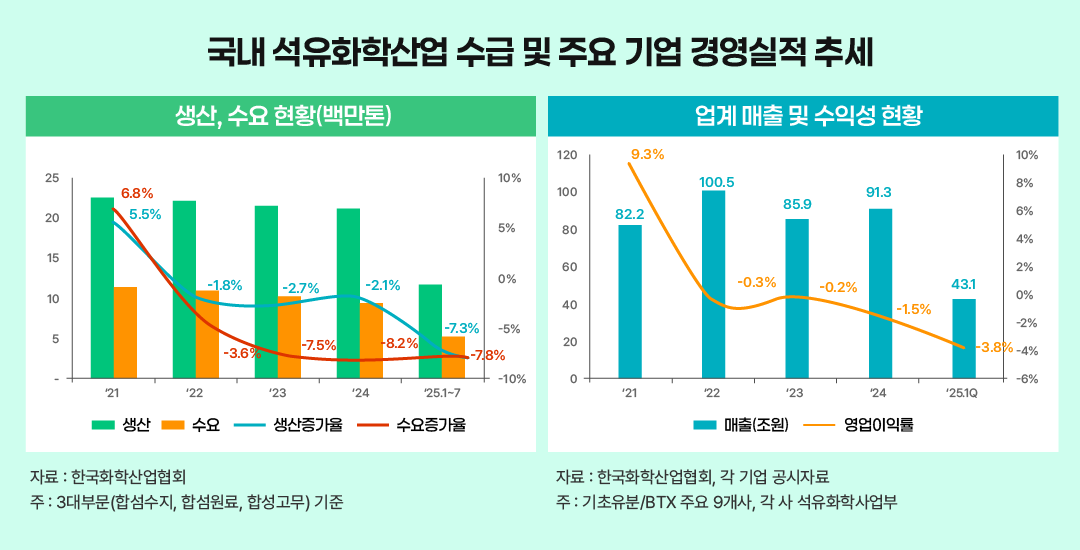
China’s petrochemical industry has secured a complete supply chain by starting with downstream operations and expanding upstream production facilities. Furthermore, the industry is continuously expanding its production capacity, approaching complete self-sufficiency. This represents a structural change, with the disappearance of Korea’s largest export market, which previously accounted for more than half of its petrochemical exports.
At the same time, the domestic petrochemical industry is facing pressure to decarbonize due to strengthening domestic and international environmental regulations. The European Union’s Carbon Border Adjustment Scheme is expected to expand its scope to include plastics and petrochemical products, which will impose additional export costs on domestic petrochemical companies. Decarbonization of the entire petrochemical supply chain will now become a vital strategy for the survival of petrochemical companies.
The domestic petrochemical industry must move beyond its existing growth model, which relies on economies of scale to secure cost competitiveness, and discover new growth engines. These new growth engines can be secured by addressing domestic and international environmental regulations through decarbonization of the entire petrochemical supply chain, while simultaneously transforming the profit structure by preemptively capturing high-value-added downstream niche markets.
Measures to Strengthen the Competitiveness of the Domestic Petrochemical Industry
1) Decarbonization of the entire supply chain
The petrochemical industry, along with steel, oil refining, and cement, is a major greenhouse gas emitter and a difficult sector to reduce emissions. The domestic petrochemical industry, in particular, relies on fossil fuels, particularly petroleum, not only as fuel but also as raw materials. Therefore, reducing greenhouse gases requires a combination of eco-friendly energy alternatives and raw material diversification strategies.
A key strategy for eco-friendly energy alternatives is to replace the fuel used in naphtha cracking centers with electricity. Leading global petrochemical companies, such as BASF and SABIC, have already entered the demonstration phase of cracking centers equipped with electric furnaces, and Korea is also developing core technologies related to electric furnaces, centered around the Korea Institute of Industrial Technology. Consequently, securing green power will emerge as a key competitive advantage for petrochemical companies. Therefore, domestic petrochemical companies should actively consider Dow’s strategy of introducing small modular reactors (SMRs) to their production facilities to secure carbon-free fuel.
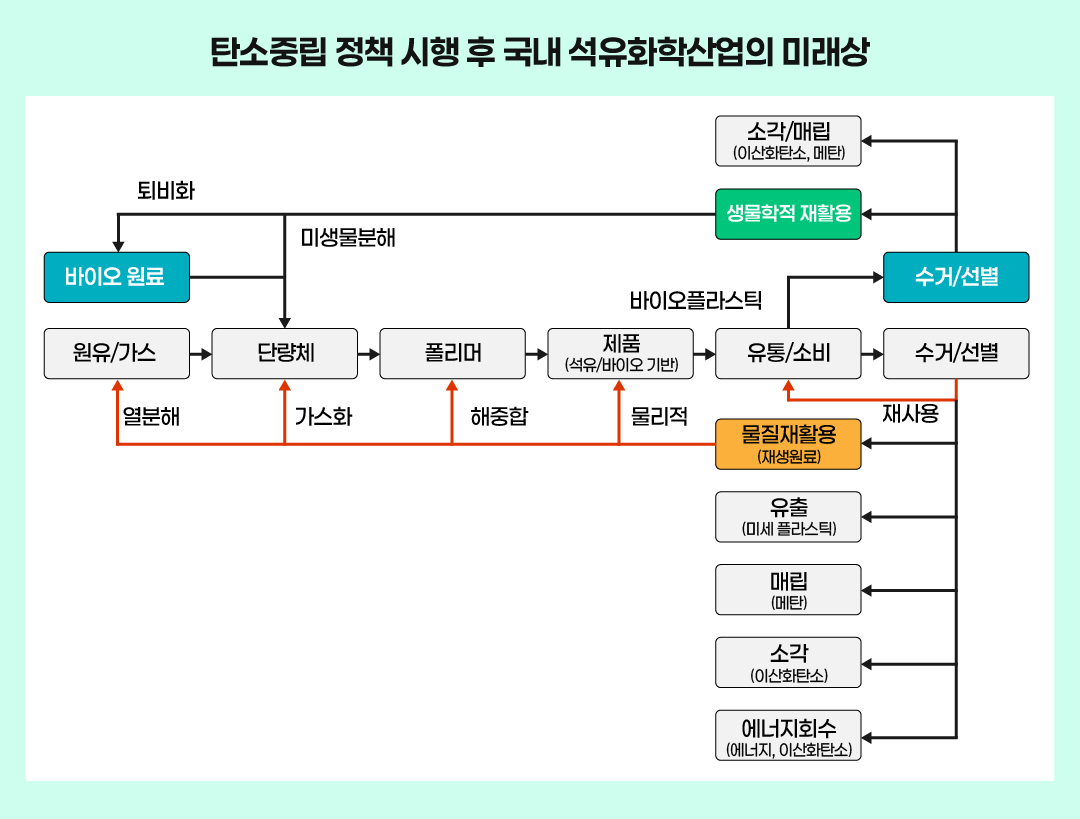
A prerequisite for a raw material diversification strategy is establishing a circular economy in which the collection, sorting, and recycling of waste plastics enters the existing petrochemical supply chain. To secure the level of waste plastic demanded by petrochemical companies within a circular economy, a more rigorous waste plastic sorting system must be introduced to improve conversion rates. SK Chemicals acquired the chemical recycling raw materials and PET business assets of China’s Shuye in 2023, and Shell also acquired pyrolysis oil production technology in 2021 by acquiring a stake in BlueAlp, a plastic recycling technology company.
2) Preoccupying high value-added downstream niche markets
Since the early 1990s, as the Korean and Taiwanese petrochemical industries expanded their production capacity, Japanese petrochemical companies, having lost cost competitiveness in the commodity product market, pursued a strategy of shifting their portfolios toward downstream product lines. Korean petrochemical companies, facing a similar structural transformation, also need to adopt a strategy of expanding into downstream or non-chemical sectors and focusing on specialty product production.
However, since leading companies from Europe, the US, and Japan already dominate the global specialty market, Korean petrochemical companies must focus on niche specialty markets. To achieve this, in the short term, they should develop specialty products aligned with Korea’s core industries and participate in their supply chains. Representative examples include ultra-lightweight materials for next-generation mobility, battery materials, and high-purity insulators for electrical and electronic products. As demand industries increasingly demand increasingly sophisticated material properties, Korean petrochemical companies will need to significantly expand their R&D investments.

Policy support to drive industrial transformation
According to a recent study by the Korea Institute for Industrial Economics & Trade, domestic petrochemical experts identified decarbonization and green transition across the entire supply chain as areas most in need of government support. The innovative technologies required for this green transition require large-scale, long-term investment, so government policy commitment and support are essential to alleviate uncertainty.
Government policy support can be broadly developed along three axes.
First, support for supply chain cooperation and infrastructure development is crucial. A cooperative system between major petrochemical companies and small and medium-sized enterprises (SMEs) in the forefront should be established to promote carbon footprint management and the establishment of ESG guidelines. Furthermore, energy hubs and CCUS facilities should be established near industrial complexes to ensure eco-friendly energy procurement and real-time greenhouse gas management.
Second, it’s important to create and protect new markets. To generate initial demand for domestic biodegradable plastics, it’s necessary to mandate their use for specific purposes and support a private certification system that can prevent market encroachment by low-cost Chinese products. This will help domestic companies secure a technological edge and establish a stable market base.
Third, strengthening the financial and tax base is crucial. Government-wide initiatives, including the Ministry of Trade, Industry and Energy, the Ministry of Environment, and the Ministry of Strategy and Finance, should issue bonds similar to the EU’s green bonds and Japan’s GX economic transition bonds, encouraging priority investment in infrastructure and technology development in challenging sectors. This will encourage private investment in decarbonization projects and enable large-scale facility conversions through government bond guarantees for a certain period. For example, if idle upstream facilities are replaced with eco-friendly, high-value-added production facilities, tax benefits and financial support using the proceeds from these bonds can support corporate investment decisions.
Beyond structural transformation, leading the global chemical market
The future competitiveness of the domestic petrochemical industry is expected to hinge on the green transition and the advancement of its business portfolio. If restructuring of the upstream sector, the green transition supported by government policy support, and continued investment by petrochemical companies in downstream and non-chemical sectors are achieved, the domestic petrochemical industry will overcome the current crisis and achieve a stable structural transformation. As a result, domestic petrochemical companies are expected to transform from suppliers of chemical materials to comprehensive materials solutions providers, leading the global chemical market.